
How a Digital Twin of Your Water Network Empowers Frontline Teams
Just Like Google Maps for Your Drive
Imagine driving through a busy city without Google Maps. You’d be relying on memory, static paper maps, or calling someone for directions. Now imagine trying to manage a complex water network without real-time insights. That’s the reality many frontline utility teams face—until a digital twin enters the picture.
What Is a Digital Twin?
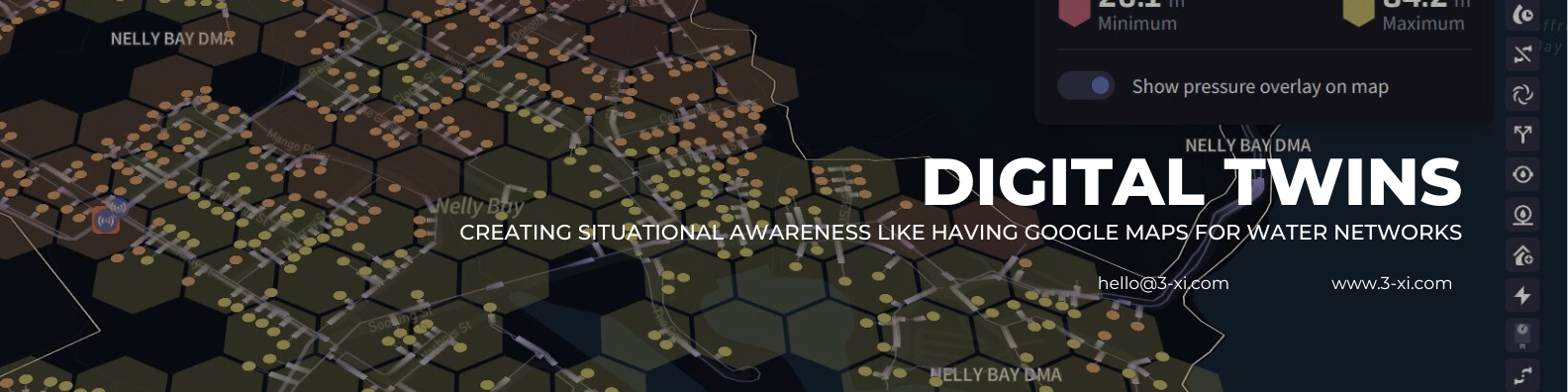
A digital twin is a dynamic, real-time virtual replica of your physical water network. It integrates data from sensors, meters, and operational systems to mirror the current state of your infrastructure. But more than just a map, it’s a living, breathing model that evolves with your network, offering insights, predictions, and situational awareness.
Situational Awareness: The Google Maps Analogy
Think about how Google Maps helps you drive:
- It shows your current location.
- It highlights traffic jams, road closures, and accidents.
- It suggests alternate routes.
- It updates in real time.
Now, apply that to a water network:
- Current Location: The digital twin shows where water is flowing, where pressure is dropping, and where valves are open or closed.
- Traffic Jams: It highlights leaks, bursts, or areas of high demand.
- Alternate Routes: It suggests operational changes—like rerouting flow or adjusting pumps—to maintain service.
- Real-Time Updates: It continuously ingests data, so teams always have the latest picture.
Empowering Frontline Teams
Frontline workers—technicians, operators, customer service, NRW, compliance officers, GIS, field engineers—are the backbone of water utilities. A digital twin gives them:
- Clarity: Instead of sifting through spreadsheets or outdated maps, they see a clear, visual representation of the network.
- Context: They understand not just what’s happening, but why. For example, a pressure drop isn’t just a number—it’s linked to a nearby valve closure or a pump failure.
- Confidence: With predictive insights, they can act proactively, not reactively. They know what to fix, where to go, and what tools to bring.
- Collaboration: Everyone—from the control room to the field—works from the same source of truth, reducing miscommunication and delays.
Information When You Need It, How You Understand It
Just like Google Maps doesn’t overwhelm you with every road in the country, a digital twin filters and prioritizes information:
- Alerts are contextual and actionable.
- Dashboards are tailored to roles—operators see different data than planners.
- Mobile Access ensures field teams get updates on the go.
The Bottom Line
A digital twin transforms how water utilities operate. It’s not just a tech upgrade—it’s a shift in how teams understand and interact with their network. Like Google Maps for your drive, it gives you the right information, at the right time, in the right way.
And when your teams are empowered with that kind of clarity and control, they don’t just respond to problems—they prevent them.